Exactly one year ago I wrote a post about J-Rock, where I shortly mentioned the phenomenon of Visual Kei. Visual Kei is a part of the Japanese music scene, and though some people talk about Visual Kei as if it were a music genre, it’s actually rather a culture or a movement among Japanese musicians.
The term Visual Kei
In Japanese, Visual Kei is written as ヴィジュアル系 (vijuaru kei), which literally means “visual style” or “visual system”. The name Visual Kei is said to come from the slogan “Psychedelic Violence Crime of Visual Shock”, created by the band X-Japan (which had an imporant role in the creation of Visual Kei).
The term was used for the first time in the magazine SHOXX in the beginning of the ’90s as “Visual Shock Kei” (ヴィジュアルショック系), which later changed to “Visual Kei”. Another word that was used for Visual Kei bands back then, was “Okeshou Kei” (お化粧系, makeup style), but because Visual Kei is about more than just makeup (as I will explain in a bit), this word is less fitting to describe the phenomenon.
A short history of Visual Kei
As I said, Visual Kei is not a music genre. The reason why people often get the impression that it is a music genre, is because a lot of Visual Kei bands are hard rock or metal bands. But this is definitely not always the case, as there are also Visual Kei bands that for example make pop music.
But if it’s not a music genre, then what is it?
Visul Kei is rather a culture of movement that is mostly about being unique and different from mothers. The the goal was to stand out and shock people. And, as the name Visual Kei already implies, they do this mostly through visual effects: the way of performing which is often very theatrical, the appearance of the artists themselves (showy makeup, hair style and clothing), and more. In some bands the members also take on a specific persona and play a role (e.g. Kamijo from Versailles, who plays the role of a vampire prince).
This style often comes with an androgynous look (e.g. Uruha from the GazettE), for some artists more than other. Because of this, people who see a Visual Kei band for the first time often assume there are multiple women in the band, though most musicians within the Visual Kei scene are men. Some men even constantly dress up as women (e.g. Mana from Moi dix Mois, also known from his time in MALICE MIZER). But watch out, the women can also look quite manly (e.g. Omi from Exist Trace).

In terms of music, most Visual Kei bands start out rather experimental. Some bands keep this experimental sound, but others start leaning more towards mainstream music as time goes on, while still belonging in the Visual Kei scene (for example DIR EN GREY, you can read more about this in the blog I wrote about them earlier this year).
The emergence of Visual Kei
Visual Kei started in the ’80s, with bands such as X-Japan, Buck-Tick and D’erlanger as pioneers. These original Visual Kei bands took inspiration from glam metal, punk and gothic rock, and put strong emphasis on shocking visuals, which became an important characteristic to the Visual Kei movement.
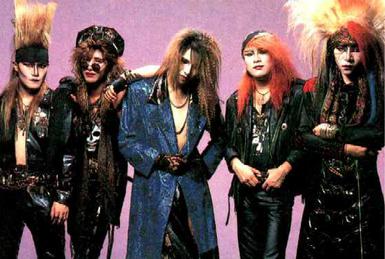
In the ’90s there was a real band boom in the Visual Kei scene, with DIR EN GREY, L’Arc-en-Ciel and MALICE MIZER as some important bands. Visual Kei also started getting more mainstream attention and gained popularity, until some important bands disbanded in the late ’90s and early 2000s (such as X-Japan, MALICE MIZER and LUNA SEA). Because of this Visual Kei went back to being an underground subculture.
In this underground scene there was a new wave of Visual Kei bands in the 2000s, much more varied than the generation before. The reason for this variety was that there were a lot of bands who didn’t make rock or metal music, but still showed the characteristics of Visual Kei (namely, standing out through their look). And there were also new bands that dit make metal music, but that differed from traditional Visual Kei in other ways. This caused the emergence of a bunch of subgenres within Visual Kei.
In the middle of the 2000s Visual Kei gained an imporant international fanbase, and a lot of bands now do concerts in the west. There was also an emergence of more female artists in the Visual Kei scene (such as all-female band Exist Trace), however it is still predominantly male.
Subgenres
Visual Kei has many subgenres, but I will not talk about all of them. I will only mention the ones that I know best myself. It is also important to know that bands don’t always fit within one specific subgenre. There are bands that belong to multiple subgenres, or that don’t fit within any of them. Then, there are also bands that change over the years and shift from one subgenre to another.
Kote Kei (コテ系)
The name comes from the Japanese word “kotekote”, wich means “over the top”. This is the traditional or old school style of the original Visual Kei bands in the ’80s and ’90s (like X-Japan). Back then this term didn’t exist yet, the name Kote Kei was created in the 2000s, when Visual Kei started becoming more varied. The characteristics of this style are the very big hairdos and extravagant makeup. The bands wear mostly black or dark clothes, but for ballads they sometimes dress mainly in white.
Neo-Visual Kei (ネオ・ヴィジュアル系)
These bands don’t have those extravagant looks anymore that the original Visual Kei bands had, and lean more towards street fashion, but the clothes are generally still very dark. In terms of music they often make heavy music, influenced by alternative metal, nu-metal and metalcore. An example of this is the band the GazettE (about which I wrote a blog last year).

Angura kei (アングラ系)
The word “angura” comes from the word “underground”, which is pronounced as “andaguraundo” in Japanese. This syle is based on a cultural movement in Japan in the ’60s, involving independent theater and political unrest. Typical about this style is the use of traditionl Japanese clothes and musical instruments. A clear example of this is the band Kagrra (神樂, kagura). Their clothing is clearly inspired on traditional Japanese clothes, and one of the guitarists also plays koto (箏), a traditional Japanese string instrument.

Eroguro Kei (エログロ系)
Angura Kei is related to Eroguro Kei, and bands are often somewhere on the line between these two genres. The name Eroguro Kei is a combination of the words “erotic” and “grotesque”. This style is inspired by the eroguro movement in the ’20s and ’30s, and includes sexual and grotesque themes, which are often bizarre and shocking. An example of this is the band cali≠gari.
Tanbi Kei (耽美系)
Tanbi means “aesthetics”. This style is strongly inspired by European renaissance, both in terms of clothing and music. Some returning themes are religion, aristocracy, and more. In terms of music this subgenre often leans towards gothic metal or symphonic metal. A known example of this style is the band Versailles.

Oshare Kei (オサレ系)
Oshare means “fashionable” of “stylish”. These bands often make pop (rock) or dance rock, instead of hard rock and metal, which is more common in Visual Kei. The songs often have more positive themes, compared to the darker lyrics that are usual for other subgenres of Visual Kei. They wear clothes with brighter and/or lighter colours, and often more casual. It looks much more like street fashion, compared to the other subgenres. An example of this style is the band Antic Café.
Koteosa Kei (コテオサ系)
This is a combination of Kote Kei and Oshare Kei. This style is not as extreme as Kote Kei, and in this way is more like Oshare Kei, but it uses more black and darker colours. The music is also darker compared to Oshare Kei bands, but still leans towards the pop rock genre instead of metal. This is also a style Antic Café uses a lot.
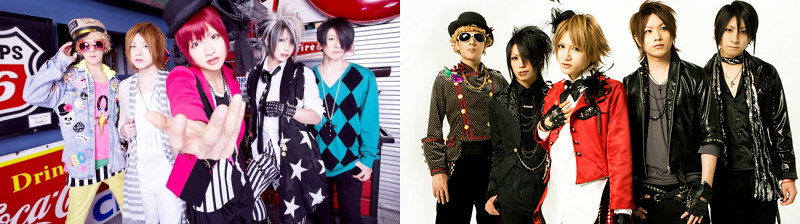
Though this overview of subgenres is far from complete, it does make clear that Visual Kei is not just one clothing style and one music genre, but it is a very broad concept with a lot of subdivisions that are very different from one another.
Whether you are a fan of pop music or heavy metal, whether you prefer cheerful music and visuals or you prefer something darker, somewhere within the world of Visual Kei is probably a band that suits you.
 One Of The Two